
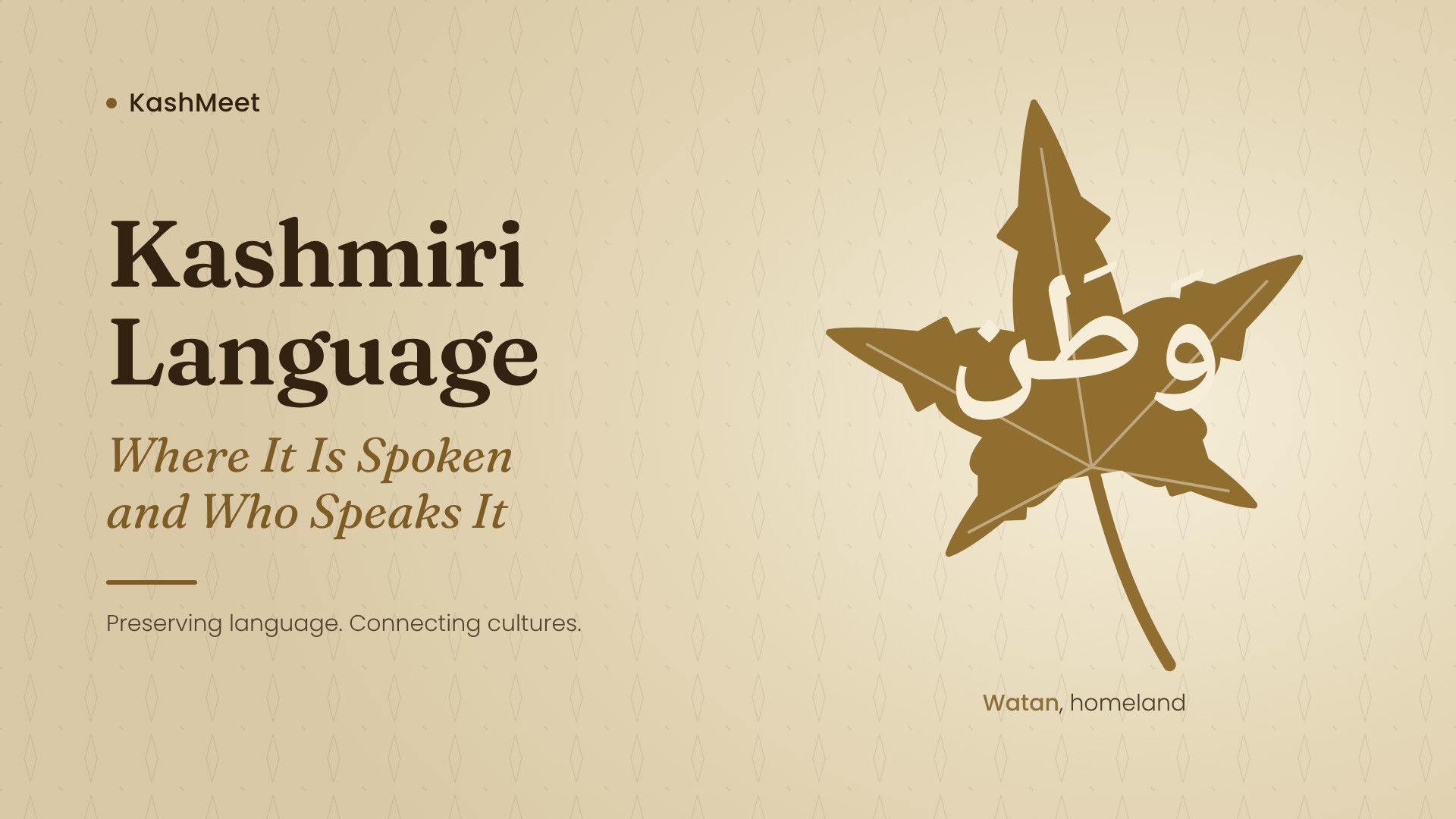
The Kashmiri language is an important part of the cultural and linguistic identity of Kashmir. Spoken across generations, it connects people with their families, communities, literature, oral traditions, and shared heritage. Although the language is most closely associated with the Kashmir Valley, its speakers also live in other parts of India and in countries around the world.
For some people, Kashmiri is the language they use every day at home. Others understand it through conversations with parents and grandparents, while some develop an interest in it because of their family background or connection to Kashmiri culture.
These different experiences reflect the language's continuing presence in a changing world.
But where is the Kashmiri language spoken? Who speaks it today, and what makes it distinct from other languages used in the region? Understanding these questions provides a broader picture of Kashmiri as a living language with a rich cultural identity.
What Is the Kashmiri Language?
Kashmiri is an Indo-Aryan language belonging to the Indo-European language family. It is historically associated with the Kashmir Valley and has its own vocabulary, grammatical structures, pronunciation patterns, and literary traditions.
Over centuries, the language has developed through everyday communication and interaction with neighbouring communities. Its vocabulary reflects contact with languages such as Persian, Arabic, Sanskrit, and others. However, these influences do not make Kashmiri a variety of any of those languages. It remains a distinct language with its own linguistic characteristics.
Kashmiri is used in family conversations, social gatherings, poetry, storytelling, music, and other forms of cultural expression. Its importance extends beyond communication because it also carries memories, traditions, and knowledge from one generation to another.
The language is one part of Jammu and Kashmir's wider linguistic diversity. Different communities across the region speak different languages, each with its own history and cultural significance.
Where Is the Kashmiri Language Spoken?
1. The Kashmir Valley
The Kashmir Valley is the principal geographical centre of the Kashmiri language. It is spoken across numerous towns, villages, and urban communities, including Srinagar, Anantnag, Baramulla, Kupwara, Budgam, Pulwama, Bandipora, Ganderbal, Kulgam, and Shopian.
In many households, Kashmiri is used for everyday conversations between parents, children, grandparents, relatives, and neighbours. It is also associated with local storytelling, folk traditions, poetry, and social gatherings.
The frequency of use varies between families. Some households use Kashmiri as their main language of communication, while others regularly alternate between Kashmiri and languages such as Urdu, English, or Hindi.
These differences are particularly noticeable in multilingual environments, where people often adjust the language they use according to their surroundings and the people with whom they communicate.
2. Urban and Rural Communities
Kashmiri is spoken in both urban and rural areas of the Kashmir Valley. In cities such as Srinagar, speakers commonly use Kashmiri alongside other languages in their personal and professional lives.
Urban environments often bring together people from different linguistic backgrounds. A person might speak Kashmiri with family members, use English in a professional setting, and communicate in another language in a different social situation.
In rural communities, Kashmiri can play an important role in family networks, local interactions, and oral traditions. Conversations between generations provide opportunities for children to become familiar with the language and its expressions.
However, language use is not determined by whether a person lives in a city or village. Family practices, education, social networks, and individual circumstances all influence how frequently Kashmiri is spoken.
3. Other Parts of Jammu and Kashmir
Kashmiri speakers also live outside the central Kashmir Valley, including in other parts of the Union Territory of Jammu and Kashmir.
The wider region is linguistically diverse. Dogri, Gojri, Pahari varieties, Shina, Balti, and other languages are spoken by different communities. Urdu, Hindi, and English also have roles in various social and official settings.
These languages have their own identities and histories. Not everyone living in Jammu and Kashmir speaks Kashmiri, and the language should not be treated as interchangeable with the other languages spoken in the region.
Kashmiri is especially associated with the Kashmir Valley, while the broader region includes many distinct linguistic traditions.
4. Kashmiri in Other Parts of India
Kashmiri is also spoken by people who live outside Jammu and Kashmir. Families have moved to other Indian states for education, employment, business, and personal reasons, establishing communities in cities such as Delhi and other major urban centres.
For some families, Kashmiri remains an important language at home. Others use it alongside the languages of the places where they live.
Children growing up outside Kashmir may hear Kashmiri from their parents or grandparents while using English, Hindi, or another language more frequently at school and with friends. As a result, their understanding of Kashmiri may be stronger than their ability to speak it.
These experiences demonstrate that language use depends on more than geographical location. Family communication and opportunities to interact with other speakers also play an important role.
5. Kashmiri Around the World
Kashmiri-speaking families live in several countries, including the United Kingdom, the United States, Canada, and other parts of Europe and the Middle East.
For many diaspora communities, Kashmiri provides a connection to relatives, family history, and cultural identity. Some households use the language regularly, while others speak it mainly during family gatherings or conversations with relatives in Kashmir.
Children growing up abroad may encounter several languages from an early age. The language used at school and in wider society may differ from the language spoken by their parents.
Consequently, some younger family members speak Kashmiri fluently, while others understand it but have fewer opportunities to use it actively.
This variation is common among heritage-language communities worldwide. It shows how a language can remain meaningful to people even when they live far from its traditional geographical centre.
Who Speaks the Kashmiri Language?
The people who speak Kashmiri come from different generations, locations, and personal backgrounds. Their experiences range from daily use to occasional family conversations and cultural interest.
Native Kashmiri Speakers
Native speakers generally acquire Kashmiri naturally through interaction with family and community members during childhood.
For many, it is the language of family conversations, childhood memories, social relationships, and familiar surroundings. They may use it with relatives, friends, and neighbours throughout the day.
However, native speakers do not all have the same level of use or familiarity with written Kashmiri. Some speak it regularly but rarely read or write it, while others have experience with its literature and formal language structures.
Being a native speaker and having formal knowledge of a language are related but different abilities.
Kashmiri Families and Younger Generations
Families play an important role in passing Kashmiri from one generation to the next.
Children who regularly hear and use the language at home have opportunities to develop their speaking and listening skills naturally. Conversations with parents, grandparents, siblings, and relatives can help keep Kashmiri part of everyday life.
However, some children grow up hearing Kashmiri without using it as frequently themselves. They may understand what their relatives say but respond in another language.
This difference between understanding and speaking is common in multilingual households. It does not necessarily mean that children have lost their connection to Kashmiri; it may mean they have had more opportunities to listen than to participate in conversations.
Heritage Speakers
Heritage speakers are people who have a family or cultural connection to a language but may not use it as frequently as those who speak it every day.
Some Kashmiri heritage speakers grow up outside Kashmir or in households where another language is used more often. Their abilities vary considerably.
One person may understand most family conversations but struggle to respond. Another may speak comfortably about familiar subjects but find more complex discussions difficult.
For many heritage speakers, reconnecting with Kashmiri is connected to family relationships, cultural identity, or a desire to understand their background more deeply.
Their experiences demonstrate that a person's relationship with a language cannot be measured only by where they live or how often they speak it.
People Learning Kashmiri Through Cultural Interest
Not everyone who speaks Kashmiri has a Kashmiri family background. Some people develop an interest in the language through friendships, relationships, travel, academic research, literature, or an interest in South Asian languages.
For these individuals, Kashmiri can provide another way to communicate with speakers and understand the region's cultural traditions.
Their reasons for engaging with the language may differ from those of native and heritage speakers, but they contribute to the wider community of people interested in Kashmiri.
How Many People Speak Kashmiri?
The number of Kashmiri speakers depends on the source, reference year, and definition used to count them.
India's 2011 Census provides official mother-tongue statistics for Kashmiri. These figures are useful for understanding reported language distribution, but they should be identified as historical census data rather than a current count.
It is also important to distinguish between people who report Kashmiri as their mother tongue and those who can speak or understand it as an additional language.
For example, someone may speak Kashmiri fluently but identify another language as their primary mother tongue. Another person may understand Kashmiri through family conversations but use it only occasionally.
These differences make it difficult to describe the entire Kashmiri-speaking population using one number.
When discussing speaker figures, it is best to provide the source and year of the data and explain whether the number refers to mother-tongue speakers or a broader population of people who can speak the language.
Is Kashmiri an Official Language?
Kashmiri is one of the official languages of the Union Territory of Jammu and Kashmir, alongside Dogri, Urdu, Hindi, and English.
This recognition reflects the language's importance within the region's cultural and linguistic landscape. However, official status does not mean that everyone in the territory speaks Kashmiri or that it is used equally in every institution and social setting.
Everyday language use also depends on family communication, education, media, employment, and community traditions.
Official recognition and continued use among speakers are different aspects of a language's position in society, and both are important when considering its future.
Which Script Is Used for Kashmiri?
The Kashmiri language has a distinctive written history, with more than one script associated with it.
The Perso-Arabic script, in a form adapted for Kashmiri, is widely associated with contemporary written Kashmiri. Devanagari has also been used to write the language, while the historical Sharada script is closely connected with Kashmir's manuscript and literary heritage.
The script used can depend on historical context, community, publication, and purpose.
The existence of different scripts does not mean that Kashmiri becomes a different language when written in another script. Language and writing system are related, but they are not the same thing.
Understanding Kashmiri therefore involves recognising both its spoken traditions and its varied written history.
Why Is the Kashmiri Language Important?
The Kashmiri language has significance beyond everyday communication. It carries cultural knowledge, family memories, literature, and traditions that connect people across generations.
Cultural Identity and Family Connections
For many speakers, Kashmiri is associated with parents, grandparents, childhood experiences, and familiar places. These connections can remain meaningful even when people move away from the Kashmir Valley.
For diaspora families, understanding or speaking Kashmiri may provide a connection with relatives and family history.
Literature and Oral Traditions
Kashmiri has a literary tradition that includes poetry and other forms of creative expression. Oral storytelling, folk traditions, and everyday expressions also help preserve cultural knowledge.
These traditions show how a language can communicate more than information. It can also carry experiences, humour, values, and memories that are meaningful to a community.
Preserving the Language Across Generations
The continued use of Kashmiri depends partly on opportunities for people to speak it in daily life.
Family conversations, storytelling, cultural gatherings, and communication with fluent speakers can help maintain the language. Digital communication can also help people living far from Kashmir stay connected with relatives and other speakers.
For those who want to improve their speaking ability, platforms such as KashMeet offer one-on-one lessons with native Kashmiri tutors, providing an additional opportunity to engage with the language.
Frequently Asked Questions About the Kashmiri Language
Where is the Kashmiri language spoken?
Kashmiri is primarily associated with the Kashmir Valley in the Union Territory of Jammu and Kashmir, India. Speakers also live in other parts of India and in countries where Kashmiri families have settled.
Who speaks Kashmiri?
Kashmiri is spoken by native speakers, families living outside Kashmir, heritage speakers, diaspora communities, and people who develop an interest in the language.
Is Kashmiri spoken outside India?
Yes. Kashmiri-speaking individuals and families live in countries including the United Kingdom, the United States, Canada, and other parts of the world.
Is Kashmiri the same as Urdu?
No. Kashmiri and Urdu are distinct languages with different linguistic histories and grammatical systems, although both are used in the wider region.
Is Kashmiri an Indo-Aryan language?
Yes. Kashmiri belongs to the Indo-Aryan branch of the Indo-European language family.
Which script is used for Kashmiri?
The Perso-Arabic script, adapted for Kashmiri, is widely associated with contemporary writing. Devanagari has also been used, while Sharada is an important historical script.
Do all people in Jammu and Kashmir speak Kashmiri?
No. Jammu and Kashmir is linguistically diverse, and different communities speak different languages according to their location and background.
Why do some Kashmiri children understand the language but not speak it fluently?
Children in multilingual households may hear Kashmiri regularly but use another language more often at school and with friends. As a result, their understanding may develop more strongly than their speaking ability.
Conclusion
The Kashmiri language is rooted in the Kashmir Valley, but its speakers and cultural connections extend far beyond the region. It is spoken by native speakers, families across India, diaspora communities, heritage speakers, and people who develop an interest in the language.
Its importance lies not only in its linguistic history but also in its role in family relationships, cultural identity, literature, and communication between generations.
For some people, Kashmiri is the language they use every day. For others, it is a connection to their parents, grandparents, childhood memories, or cultural heritage.
Understanding where Kashmiri is spoken and who speaks it helps reveal its place within the linguistic diversity of South Asia. Its continued presence depends on recognition, cultural engagement, and the everyday conversations through which people keep a language alive.