
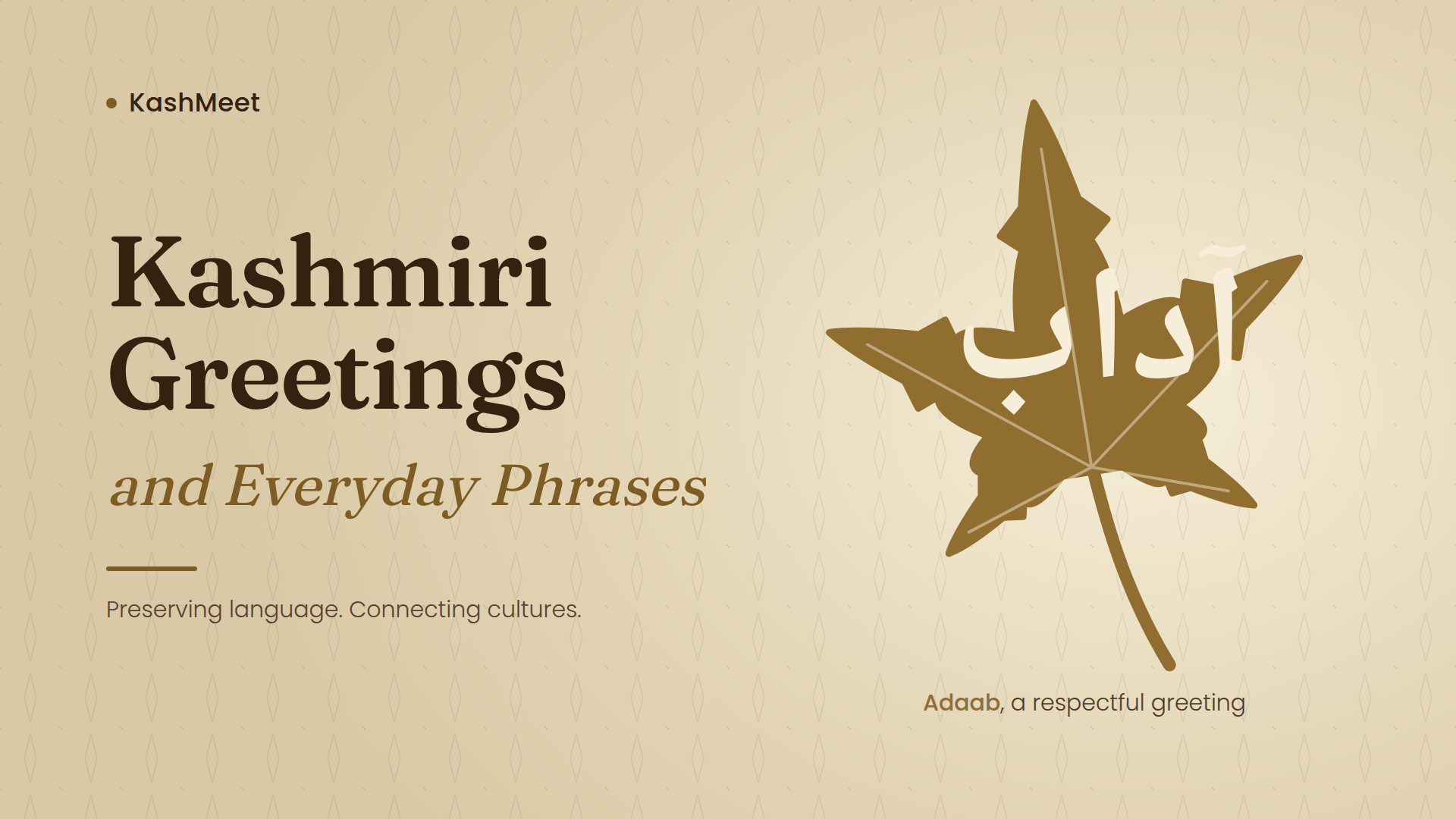
Kashmiri greetings and learning Kashmiri is much easier when you begin with the language people actually use in everyday conversations. Before worrying about detailed grammar or reading and writing, start by becoming comfortable with common greetings, questions, responses, and short expressions.
For someone learning Kashmiri to speak with family, understand conversations at home, connect with grandparents, or simply become more comfortable speaking Koshur, everyday phrases provide a practical starting point.
The most useful expressions are the ones you can hear, repeat, and use naturally in real situations.
The best way to learn everyday Kashmiri is through regular listening and conversation. Start with common expressions, understand how native speakers use them, and practice them in the situations where you would naturally say them.
Start With Everyday Kashmiri Conversations
When learning a language, it is tempting to begin by memorizing long vocabulary lists.
That is rarely the most useful approach.
Instead, think about the conversations you already have every day.
You greet someone when you meet them. You ask how they are. You ask where they are going or what they are doing. You talk about food, family, work, school, weather, and plans.
These ordinary conversations are where Kashmiri greetings and everyday phrases become useful.
Start by listening to how people around you speak. Notice which expressions they repeat and how their pronunciation changes depending on the speed and situation of the conversation.
You will quickly discover that natural spoken Kashmiri is more than a collection of individual words.
Kashmiri Greetings in Everyday Life
Greetings are usually the first expressions a learner notices.
But greetings are also connected to relationships and situations. The way someone greets an elder may not sound exactly like the way they greet a close friend.
Instead of memorizing one expression and using it everywhere, pay attention to how native speakers around you greet different people.
Listen when relatives meet after being apart.
Listen when someone enters a home.
Listen to how children greet older family members.
Listen to how friends greet one another.
This kind of observation helps you understand not only the words but also the social side of Kashmiri.
For learners, this is one reason listening to native speakers is so valuable.
Learn Complete Phrases, Not Just Individual Words
One of the most useful habits when learning Kashmiri everyday phrases is to learn expressions as complete units.
For example, instead of memorizing a word for “where” and immediately trying to construct every possible question around it, learn complete questions that you actually hear people using.
The same applies to greetings, requests, responses, and common questions.
A complete expression gives you three things at once:
Vocabulary
Pronunciation
Sentence structure
It also makes speaking faster.
When you repeatedly hear and use a complete expression, you eventually stop translating it word by word.
It simply becomes something you know how to say.
Kashmiri Phrases for Family Conversations
For many learners, family is the best place to practice Kashmiri.
You already know the people you are speaking with, so there is much less pressure than there would be in a conversation with a stranger.
Start with simple topics.
Ask someone how they are.
Ask what they are doing.
Ask where they are going.
Talk about what happened during the day.
Ask about another family member.
Talk about food.
Talk about the weather.
You do not need complicated sentences.
A short conversation that you understand is much more useful than memorizing a long list of expressions you never use.
If your grandparents speak Kashmiri, listen particularly carefully to them. Older speakers may use expressions that you do not hear as often among younger people.
Those differences are part of the language's richness.
Kashmiri Everyday Phrases Around the Home
Your home can become one of the easiest places to practice spoken Kashmiri.
You do not need to announce that you are having a language lesson.
Simply use Kashmiri during routines that already happen.
Try speaking Kashmiri when:
Someone is waking up
Breakfast is being prepared
Someone is leaving the house
Children are getting ready for school
Someone is looking for an object
Food is being served
Guests arrive
The family sits together in the evening
It is time to go to sleep
The same expressions will naturally repeat.
That repetition matters.
If you hear an expression every morning for several weeks, you are far more likely to remember it than if you write it down once in a notebook.
Learn Kashmiri Through Food
Food gives you an easy way to connect vocabulary with real experiences.
Think about what happens during a family meal.
Someone asks for something.
Someone offers food.
Someone asks whether you have eaten.
Someone pours tea.
Someone talks about what has been prepared.
These are all opportunities to hear natural Kashmiri.
If your family enjoys traditional Kashmiri food, use those moments to learn the words associated with ingredients, cooking, eating, and serving.
The same applies to tea.
A conversation around Nun Chai or Kahwa can become an effortless opportunity to practice vocabulary without making the interaction feel like studying.
The more closely a word is connected to an experience, the easier it can be to remember.
Kashmiri Questions Are Extremely Useful
Once you know some basic Kashmiri greetings, questions should be one of your next priorities.
Questions keep conversations moving.
You can ask about:
People
Places
Food
Time
Activities
School
Work
Family
Plans
Feelings
Rather than learning question words in isolation, listen to complete questions from native speakers.
Notice how the words fit together.
Then repeat the whole expression.
This will help you develop a natural sense of sentence structure without having to consciously analyze every grammatical rule.
Learn Responses Alongside Questions
A common mistake among beginners is learning how to ask a question without learning how to respond when someone answers.
Try to learn both sides of a conversation.
For every question you practice, think about a few possible answers.
For example, if you learn how to ask someone about their day, practice several ways of responding.
If you learn how to ask where someone is going, practice answering with different places.
This creates a small conversation rather than a collection of disconnected phrases.
It also makes it easier to respond without translating everything from another language.
Listen to How Native Speakers Actually Talk
Written learning material can give you a useful foundation, but everyday speech can be different.
Native speakers shorten expressions.
They speak quickly.
They use familiar words repeatedly.
They change their pronunciation depending on the situation.
Different families and regions may also have their own vocabulary and pronunciation preferences.
This is completely normal.
If you hear a phrase from one speaker and a slightly different version from another, do not immediately assume that one must be wrong.
Ask yourself:
Who is speaking?
Where are they from?
Who are they speaking to?
Is this formal or casual conversation?
These details can help you understand why spoken Kashmiri can vary.
Do Not Be Afraid of Pronunciation
Kashmiri has sounds that may be unfamiliar to learners.
Trying to reproduce every sound perfectly from the beginning can make speaking feel intimidating.
Start by listening carefully.
Then repeat slowly.
Pay attention to the shape and rhythm of the whole expression rather than worrying about every individual sound.
If you have access to a native speaker, ask them to repeat the phrase naturally and then slowly.
Record yourself if possible.
Listening back can reveal differences that you do not notice while speaking.
Your pronunciation will improve through repeated exposure.
Avoid Translating Every Sentence
If you already speak English, Hindi, Urdu, or another language, it can be tempting to construct every Kashmiri sentence by translating from that language.
Try to move away from this habit.
Instead, learn expressions as they are naturally spoken in Kashmiri.
When you hear the same expression repeatedly, eventually you will recognize its meaning without mentally translating each word.
That is an important step toward thinking directly in Kashmiri.
It also makes your speech faster and more natural.
A Simple Way to Practice Every Day
You do not need a long study session.
Try a short daily routine.
Five Minutes of Listening
Listen to a conversation, family member, story, or other spoken Kashmiri material.
Five Minutes of Speaking
Repeat expressions you heard.
Try saying them without looking at your notes.
Five Minutes of Conversation
Speak with someone who knows Kashmiri.
Ask questions and respond naturally.
Five Minutes of Review
Go over the expressions you used during the day.
This simple routine can be more effective than studying for several hours once a week.
Use the Same Phrase in Different Situations
Once you learn a useful expression, do not immediately move on to something new.
Use it repeatedly.
Use it with your parents.
Use it with your siblings.
Use it with your grandparents.
Use it in a casual conversation.
Use it again the following day.
The goal is to make the expression automatic.
When you no longer have to stop and think about how to say it, it has moved from passive knowledge into your active vocabulary.
What If You Understand Kashmiri but Cannot Speak It?
This happens to many learners who grew up hearing Kashmiri at home.
You may understand what your parents or grandparents are saying but struggle to respond.
There is nothing unusual about that.
Your listening ability has simply developed faster than your speaking ability.
The solution is more speaking practice.
Start with very short responses.
Do not wait until you can construct long sentences.
If you know one useful expression, use it.
Then add another.
Gradually, your responses will become longer.
Understanding Kashmiri already gives you an important foundation. Now you need to turn that passive understanding into active speaking.
What If You Are Completely New to Kashmiri?
If you have never spoken Kashmiri before, start even smaller.
Learn a few greetings.
Learn how to ask simple questions.
Learn expressions connected to family, food, home, and daily activities.
Listen every day.
Speak whenever you get the opportunity.
Do not try to become fluent immediately.
Your first goal can simply be having a two-minute conversation.
Once two minutes becomes comfortable, aim for five.
Then ten.
Progress becomes much easier to notice when you break it into small milestones.
A 7-Day Practice Plan
You can use the following routine to begin practicing Kashmiri greetings and everyday phrases.
Day 1 — Greetings
Listen to several natural greetings and practice saying them aloud.
Day 2 — Questions
Learn a few everyday questions and practice asking them.
Day 3 — Responses
Practice answering those questions.
Day 4 — Family
Use Kashmiri while talking with a family member.
Day 5 — Food
Practice Kashmiri during a meal or while preparing food.
Day 6 — Listening
Spend time listening to natural Kashmiri conversation.
Day 7 — Conversation
Try to have a short conversation using everything you practiced.
Do not worry about mistakes.
The goal is to use the language.
Common Mistakes Beginners Make
Memorizing Huge Lists
You do not need hundreds of phrases at once.
Start small and use what you learn.
Only Studying Written Kashmiri
If your goal is speaking, spend plenty of time listening and speaking.
Being Afraid of Mistakes
Mistakes are unavoidable.
They are also useful because they show you what you need to practice.
Copying Expressions Without Understanding Context
A phrase that works with a close friend may not be the expression you would naturally use with an elder.
Listen to how native speakers use language in different situations.
Giving Up Too Early
It takes time before a new language starts feeling automatic.
Keep using the expressions you already know while gradually adding new ones.
Frequently Asked Questions
What should I learn first in Kashmiri?
Start with everyday expressions that you can immediately use: greetings, simple questions, responses, family vocabulary, food-related words, and expressions connected to daily routines.
How can I improve my spoken Kashmiri?
Listen to native speakers regularly and speak whenever you can. Repeating complete expressions and using them in real conversations will gradually make your speech more natural.
Can I learn Kashmiri from everyday phrases?
Yes. Everyday phrases are an excellent starting point for spoken Kashmiri. Once you become comfortable with them, you can gradually expand into grammar, larger vocabulary, reading, and writing.
Why do different Kashmiri speakers use different expressions?
Kashmiri varies across families, communities, regions, generations, and situations. Some expressions may be more common in one area or among one generation than another.
How long does it take to speak basic Kashmiri?
It depends on your exposure, existing knowledge, and how regularly you practice. Someone who hears and speaks Kashmiri every day can build conversational ability much faster than someone who only studies occasionally.
Keep Speaking, One Conversation at a Time
You do not need to know every Kashmiri word before you start speaking.
Start with the expressions you understand.
Use them with people around you.
Listen carefully to their responses.
Notice how they phrase things.
Then try again.
Over time, Kashmiri greetings and everyday phrases stop feeling like vocabulary you memorized and start becoming part of the way you naturally communicate.
That is the real goal—not simply knowing Kashmiri phrases, but reaching the point where you can use them without having to think about them.